Words are kings, contexts are queens.
Regardless the age and experience of my students, one of the biggest challenge in increasing fluency is expanding their active vocabulary. It means the range of words and phrases they can use in an organic and relaxed way without pauses and long fillers. So, in this blog post, I share my experience and my students’ experience on how we can make “words memorizing” more efficient and productive.
If you like what I am doing, support me on buymeacoffee.
Collocations: learn not words but phrases
The bigger phrases you learn, the more particular context you can embrace. So, one word “water” gives us only an understanding of a liquid. And “I watered the garden last evening” adds more context to this word. Now, we consider "water" as a verb.
With phrasal verbs (further phrasals), the memirising can be harder. Let us discuss take off.
- Please take off your coat when you come into the room.
- The plane took off five minutes ago.
- You worked hard and could take off the business.
As a result, we have three phrases: “take off your coat”, “the plane took off”, “took off the business”.
In the grammar world, the organic, natural phrases are named collocations. The more collocations we memorize, the better we can employ them in appropriate situations. Collocations, you can jot down on Post-its or a notepad. Don’t worry about writing them many times and also do not worry that you repeat them never.
Thesaurus. Associate
For example, “scrupulous work”. Scrupulous is not a word we use every day. That is why I usually show my students a dictionary of synonyms, also known as a thesaurus. Synonyms are a strong tool to create quick access in different corners of our mind. As alternatives for “scrupulous”, we can use “careful”. Much easier, right?! If I want a more comprehensive word, I can use “accurate”. Awesome! A thesaurus helps not only take into account the universe of words from one part of speech but also involve the others.
Family. Think roots
The word “name” can be a noun and a verb with the same spelling. A name refers to some title of a thing, abstractions, animals, or people. To name is a verb referring to calling or identifying objects. We also know that it is a regular verb, having suffix -ed in its past form. That is why named is also part of the family name”. Named can be an adjective - well-named component. Naming is what makes the world more diverse and attractive for exploration.
For me, family is one-root cloud of words. Often this cloud helps us build our thoughts quickly because some objects or subjects can be converted rapidly into actions or their characteristic.
For instance, think, thought, thoughts, thoughtful, thinks, thinking, thinkable, etc. The mutation of the word “think” gives us the opportunity to briskly discuss different aspects of mental perception of the world.
I need to think about your offer.
- There were lots of thoughts in my mind after the meeting.
- I rarely meet such a thoughtful person in my life.
- I will have thought about this approach and made a decision by next Friday.
Idioms + phrasals
For me, it was, and it is, the hardest aspect of active vocabulary increasing. Idioms have their own meaning and give us understanding not only about some an object, its characteristic, quality or action. They give us a full situation. And the more complicated moment when we learn a language out of native culture is that we “experience” the situation artificially, consuming it, not living it.
For example, an idiom: “learn the ropes”. Yes, we can translate it word by word. First word “learn” means to check, test, ensure, pick up, teach, educate, read, take, find out, study, memorize, discover, acquire something. This something (ropes in our case) will be cord, wire, cable, line, strand, leash=), string, etc. But the word “rope” has also an idiomatic (specific) meaning. In plural form, “the ropes” refers to the details about a specific situation, a role, a task, or a job.
So, “learn the ropes” means learning details about how to do something or how this something operates. For stronger memorization, we can go to the origins of the phrase and see that in the 17th century, “learning the ropes” meant becoming functional on a ship. Now it is more digestible, right? =)
Keep it on
A situation with phrasal verbs (here phrasals) is similar with a more abstract layout. Particles which follow verbs change the meaning of the verbs. For example, verb “keep + …”. Only KEEP ON, KEEP UP, KEEP GOING have very similar meanings. In this case, I prefer to learn (sometimes by heart) at least one sentence or phrase I am sure about.
Keep on researching and let me know what you collect.
The rain kept up all day.
Our team kept the space going as long as it could.
Why is it important to stick to a particular context with phrasals? Because keep on and keep up also have many other meanings. So if we do not know the particular context, we can lose the chance to use or to understand the verbs, their role and peculiarities.
Define
One of the ways, which is undervalued by many, is to make your own definitions for words. Defining something, we
(1) break the ice,
(2) create a bypass (in situations we forgot the word),
(3) train our thinking in the language we want to speak fluently.
When we provide a definition of a noun, it can be a thing, an animal, a person or a higher abstraction. A higher level of abstraction shows some social, political or cultural phenomenon or means a relation between objects.
- Snow is frozen-water particles, having small crystal or flake-like shapes.
- To snow refers to a weather activity when a lot of such flakes are falling from cold clouds, usually in winter with temperature below zero.
- Snowy is a characteristic of weather or landscape with snowfall or fallen snow.
- And the like, and the like.
Or, another example, a more abstract word - identity.
Identity is a unique set of characteristics helping both a person/people and outsiders to interact and communicate their needs collectively and personally. Sure, your definition can be different, and that is totally ok. My goal here is to show that when you build some definition, you think about the words/phrases from the perspective of the foreign language. The rest of the correction will be done by life =).
Mindmap it!
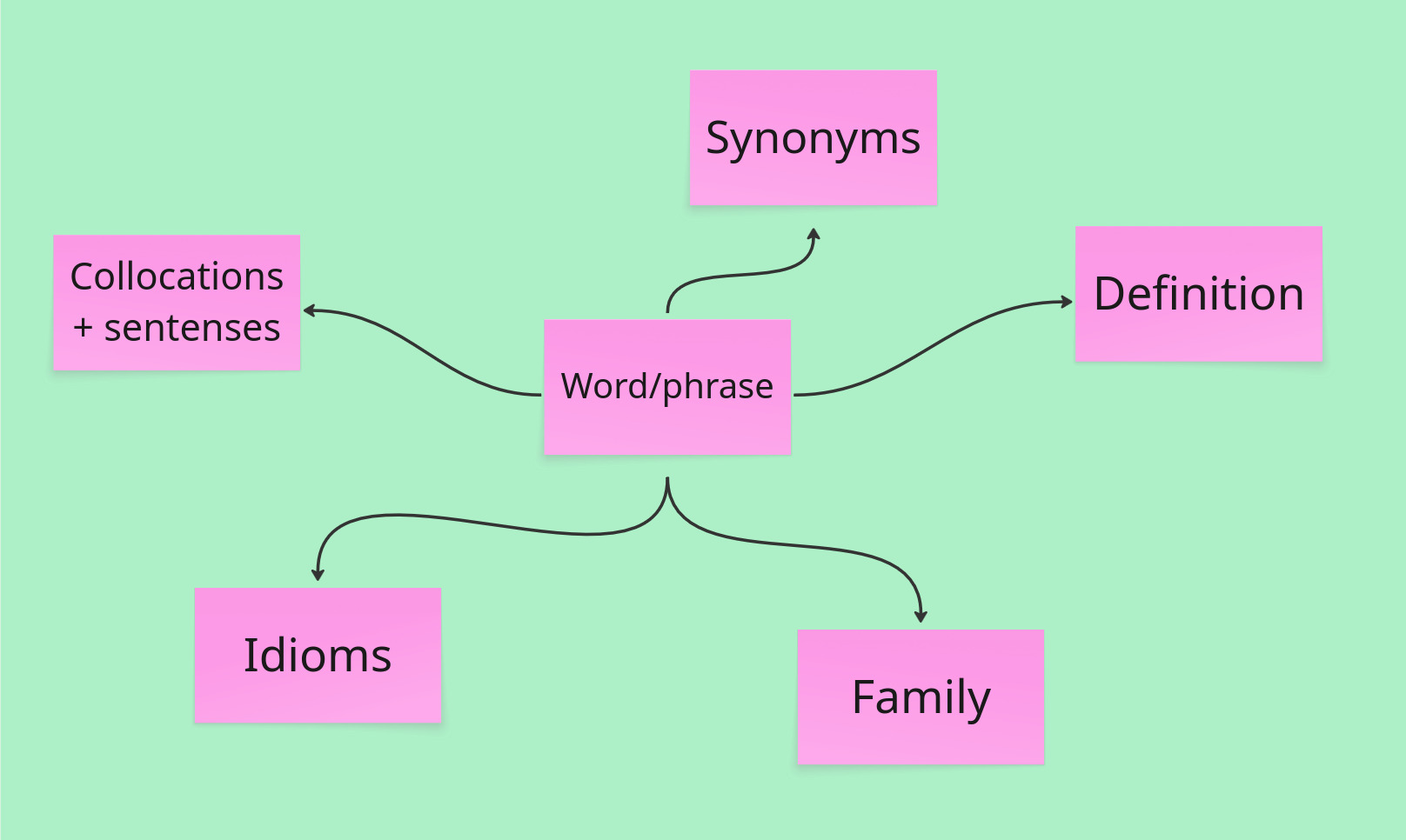
As a result of the method implementation, you can build a mind map as I’ve shared below. This kind of work takes me around 15 mins. So the piece of time is long enough. You can fill it partly, that is, definition and family or synonyms and collocations. So use the tool based on your needs and lifestyle =)
If you like what I am doing, support me on buymeacoffee.